Stop Building Agent Demos
Agentic AI Engineering teaches you how to design, evaluate, and deploy autonomous systems that don’t collapse under real constraints

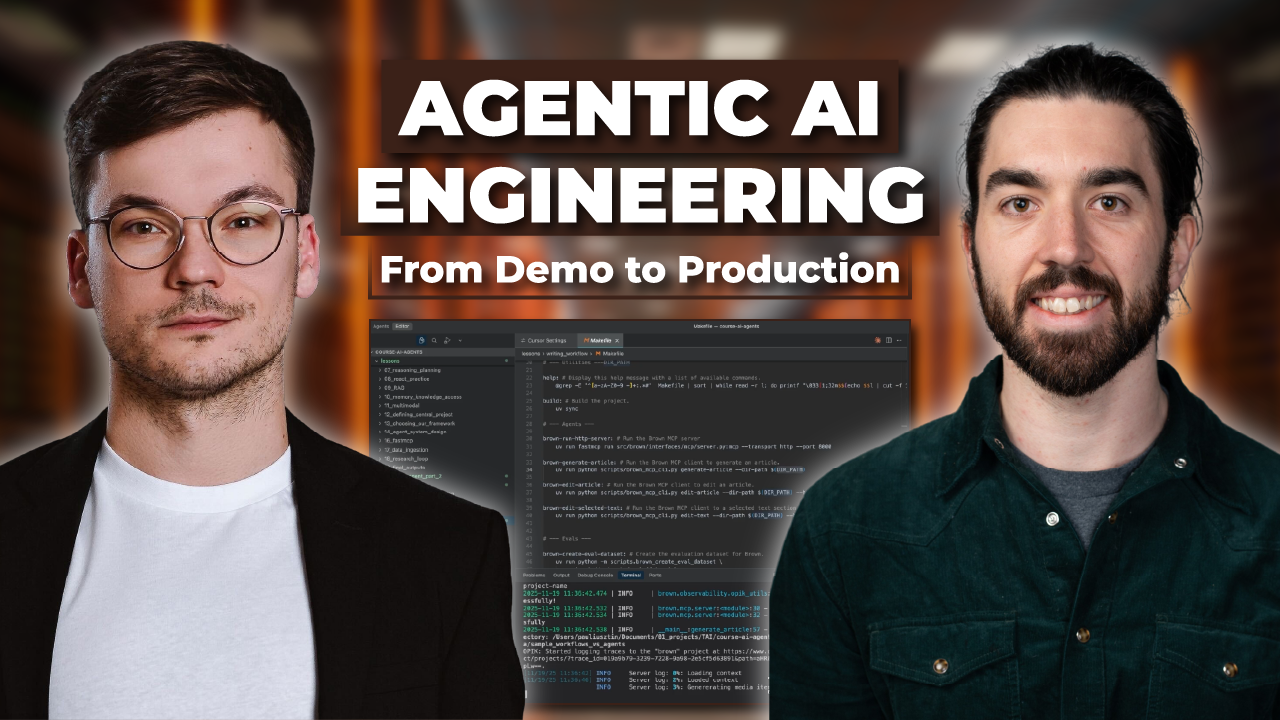
I’ve been getting this question a lot recently. “Okay, I built an agent. It works locally. Now what?” And usually what people really mean is: it kind of works, but I don’t trust it. Or worse, they deployed it, and now they don’t know how to debug it. That tension has been sitting in the back of my mind for a while.
Since 2022, I’ve had one very clear vision: build the most complete resource for engineers who want to work with real AI systems. Not prompt tricks. Not toy notebooks. Not “look, it calls a tool.” Real systems. The kind that survives production. After nine months of building, breaking, rebuilding, and stress-testing, Agentic AI Engineering is finally live. But the course is really just the surface. The real story is why we built it in the first place.
For the past few years, I always had a Plan B running quietly in parallel. A PhD. Independent consulting. Part-time work at EY. Something stable. Something safe. It was never fully gone. This year, I killed it. Completely. For the first time, I’m fully committed to building Towards AI with my partner Louie Peters and our amazing team. No fallback. And this course is probably the clearest signal of that decision. It’s not trendy. It’s not hype-driven. It’s opinionated and engineering-heavy. It reflects what we actually believe matters.
What kept bothering me is how fast the space moved from “LLMs can autocomplete text” to “everyone is building agents.” Engineers can now build impressive agent demos in a weekend. Multi-agent setups, tool calling, memory, web search, autonomous loops. On the surface, it looks incredible. And honestly, it is. Especially considering that LLMs *simply* generate tokens. But the moment those systems touch production, something changes. They become unstable. They are not in a controlled environment anymore. And, to be honest, users never behave as expected. Not because the model is dumb. Not because autonomy is impossible. But because the architecture wasn’t designed for real constraints. There’s no evaluation framework. No observability. No monitoring. No clear reasoning about when autonomy is justified and when it’s just complexity theater. No deployment discipline. Nobody was teaching the gap between “it runs” and “it ships reliably.” And that gap is everything.
So Paul and I didn’t start by outlining modules or recording lessons. We started by building a system. A real research and writing agent system that we would actually use. We crawled sources, iterated with reasoning loops, split responsibilities across components, merged them back, overengineered things, simplified them again, reduced tool counts when selection started degrading, introduced validation loops, redesigned them when they gave useless feedback, added human checkpoints, instrumented tracing, wrapped authentication around it, managed state properly, deployed it, and then watched where it cracked. We hit context overload. We hit tool explosion. We hit non-deterministic behavior that looked fine in logs but broke downstream logic. All the friction you don’t see in polished demos.
Then we opened it to 180 alpha testers for nine months. Since May 2025 to… today. That’s when things got interesting. They pushed the system in directions we hadn’t. They built on top of it. They tried different deployment environments. They forced edge cases. And every time something broke, we asked ourselves: is this a tooling issue, a framework issue, or a thinking issue? Most of the time, it was a thinking issue. Basically, the hard part isn’t calling tools. It’s making disciplined decisions about architecture, validation, autonomy boundaries, and evaluation.
Here's a quick video giving more context to the course:
In the course, you build two agents. But that’s not really the point. The point is how and why they’re built the way they are. You build a Research Agent that actually runs iterative loops, integrates real tools, produces structured artifacts, and supports human-in-the-loop checkpoints with clear stopping conditions. Then you build a Writing Workflow Agent that transforms that research into structured, multi-modal outputs with evaluator–optimizer patterns, orchestration, versioning, and state. And you don’t just make them work once. You evaluate them. You design datasets. You implement LLM judges. You add observability with tracing. You containerize everything. You deploy to the cloud. You wire up CI/CD. You add authentication. You manage state in a database. Because prompting is the easiest part. Reliability is the real work.
One thing I’m very intentional about is not overfitting this to whatever framework is hot this quarter. LangGraph might evolve. CrewAI might evolve. APIs will definitely evolve. And… agents replace us for managing all of these. One thing you need to keep and shouldn’t “devolve” with your Claude Code use is your engineering judgment. When do you use a workflow instead of an agent? When does autonomy add value, and when does it just add latency and cost? How many tools before selection degrades? When do you split into multi-agent, and when are you just creating coordination overhead? How do you design thin agents and heavy tools? How do you build validation loops that return actionable feedback instead of vague quality scores? How do you think about observability before things go wrong instead of after? These are the questions that actually matter.
This isn’t beginner content. You should be comfortable with Python. You’ve used LLM APIs. You understand Docker and basic cloud concepts. You’re okay debugging things that don’t fail cleanly. You will sweat a bit. That’s intentional. Production engineering isn’t passive.
We’ve shipped 20+ AI applications. We’ve taught hundreds of thousands of engineers through Towards AI. We wrote Building LLMs for Production. Paul wrote the LLM Engineer’s Handbook. And still, we kept seeing people stuck in what I call demo purgatory. Impressive prototypes. No production discipline. This course is our answer to that. Not “agents will replace everything next year.” Not “fully autonomous companies.” Just a very pragmatic stance: if you’re going to build agents, build them properly.
We quietly opened this to our close community first, and 75 seats are already gone. We’re releasing the first 100 early-bird seats at $449 before the price increases. You get lifetime access, ongoing updates, Discord access, live introductory calls, and a 30-day refund if you go through the early material and realize it’s not what you need. No friction.
If you’re building agents right now and you’ve felt that subtle instability, that quiet “I hope this doesn’t break in production” feeling, that’s exactly what this course is designed to address. Let’s stop optimizing for demos. Let’s build systems that survive production.
Enroll now and unlock lifetime access (with all future updates): https://academy.towardsai.net/courses/agent-engineering?ref=1f9b29