
The short version
Coding assistants such as Copilot and ChatGPT can suggest useful completions, but their output still needs technical and legal scrutiny. David Mertz’s interview uses regular-expression puzzles to show both help and failure: a suggestion may hallucinate, look syntactically valid while missing the requested behavior, or raise plagiarism, attribution, copyright, and moral-rights questions. The post introduces those risks but leaves the detailed analysis to the recorded interview.
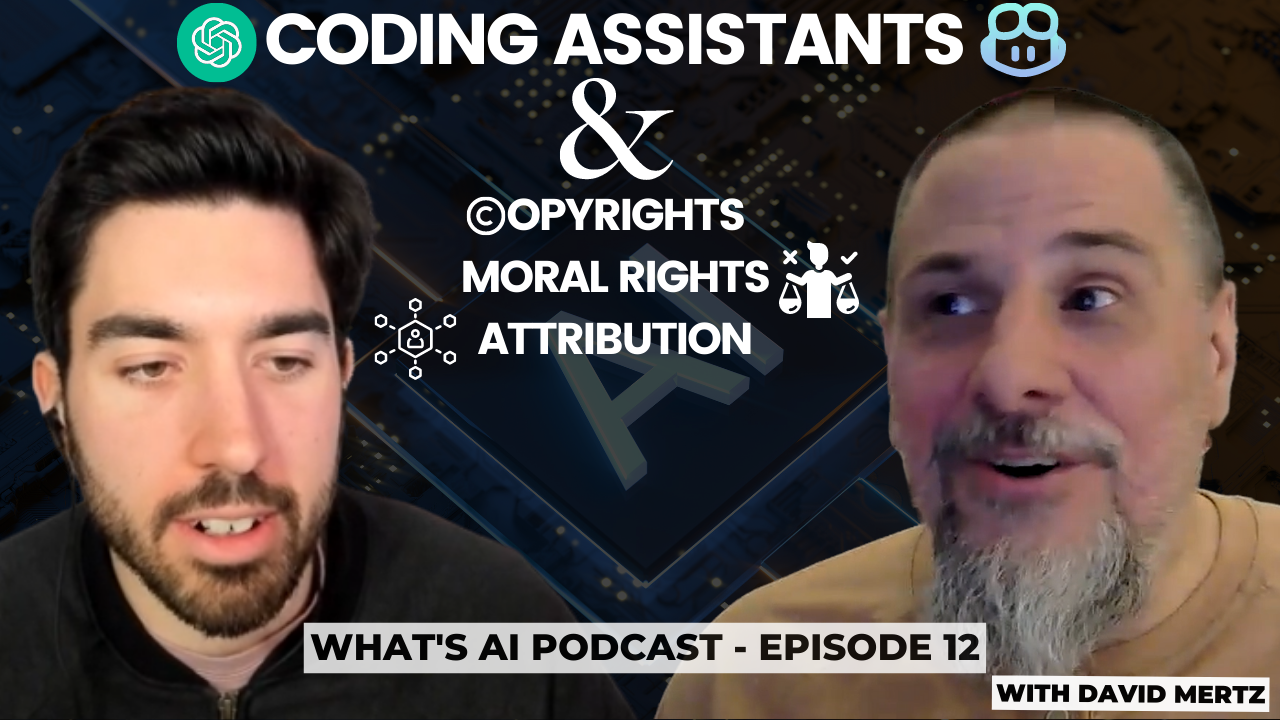
If you’re interested in generative AI and coding assistants, you won’t want to miss this interview with David Mertz, Ph.D., senior developer, data scientist, and author of “Regular Expression Puzzles and AI Coding Assistants.”
In the interview, Mertz discusses his book, which presents puzzles about regular expressions and demonstrates how new AI coding assistants, like Copilot and ChatGPT, work with them.
These AI coding assistants are revolutionizing the programming world by providing suggestions for how you might complete your code. Mertz notes that these assistants are a great help in many cases, but they can have limitations and sometimes fail. Something we need to be careful when it comes to plagiarism and arises new questions around the attribution and moral rights of such generated pieces.
Some of the limitations he identified include the potential for hallucination or the generation of entirely nonsensical content and not knowing whether code looks syntactically correct but does not perform the desired function.
So, if you’re interested in generative AI or coding assistants and the complexity with law to regulate them, check out this interview for valuable insights and a new perspective on this rapidly-evolving field. Available on Spotify or YouTube:
FAQ
Why do coding assistants raise copyright questions?
Generated code may resemble training examples, while users often cannot see the source or licensing history behind it.
Can AI-generated code still count as plagiarism?
The answer depends on similarity, provenance, jurisdiction, and use, so generated output should not be assumed original.
What technical problems can generated code contain?
It may hallucinate APIs, compile without meeting the requirement, introduce vulnerabilities, or fail on untested cases.
Who is responsible for code accepted from an assistant?
The developer and organization deploying it remain responsible for review, testing, security, attribution, and license compliance.
How should teams use coding assistants safely?
Treat suggestions as untrusted contributions and apply the same tests, reviews, and dependency checks required for human code.