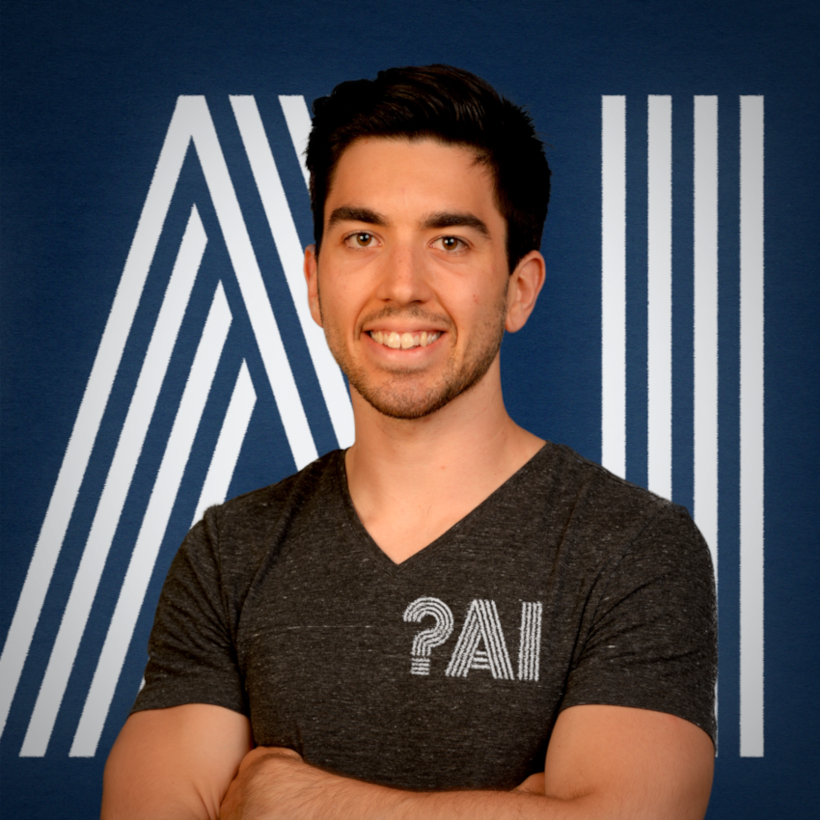
A practical map of my work
The fastest way into my work
Choose your goal, find the resources I actually recommend, and get a clear answer without reading one long wall of text.
Start here
What are you trying to do today?
There is no single perfect path. Pick the starting point that matches where you are now.
I am starting from zero
Build intuition, learn enough Python when you need it, and move forward without getting buried in tools.
Follow the beginner pathFor buildersI want to learn AI engineering
Move from LLM basics to reliable systems with RAG, agents, evals, deployment, and real projects.
Open the 2026 roadmapStructured learningI want to advance my career
Choose project-based training, build an explainable portfolio, and develop the judgment hiring teams look for.
Explore Towards AI AcademyFor teamsWe want to deploy AI at work
See how we train teams and help them build, evaluate, and ship AI systems they can rely on.
Discover Towards AIWhat I am working on
My current public focus
These are the projects getting most of my attention right now. I will keep this section updated as that changes.
More What’s AI videos
I am doubling down on YouTube with practical breakdowns of what changed and what you can actually build with it.
B2B AI training at Towards AI
We train teams to build, evaluate, and ship useful AI systems instead of stopping at scattered experiments.
Improving Towards AI Academy
We are improving the platform and courses so the path is clearer, the projects are stronger, and the material stays useful as the tools change.
Books and a few other projects
I am working on the second edition of Building LLMs for Production, alongside a few other projects I am not ready to share yet.
My recommendations
The resources I keep returning to
Do not try to consume everything. Pick one resource, build something, and return for the next one when you hit a real limitation.
Build intuition first
Start with people who can make a hard idea click before burying you in notation or framework code.
Learn with structure
Pick one path, finish it, then build. A course only helps if it gets you out of the course.
Think like an engineer
Builders I follow for honest lessons on systems, evals, security, developer workflows, and the tradeoffs hidden by clean demos.
Stay current weekly
The two feeds I actually use to keep up: deep conversations with the people shipping AI, and a rolling digest of what mattered across the field.
Build durable foundations
Practical books for products, systems, and LLM internals. Pick the one that matches your goal.
Frequently asked questions
Find the answer you need
Search a term or filter questions by what you are trying to accomplish.
Louis & What’s AI
4Who is Louis-François Bouchard?
What is What’s AI?
What’s AI is my public work across videos, articles, newsletters, guides, and conversations about AI engineering. I start from a new technique or announcement, then ask what it changes for someone who has to build, evaluate, or ship a system.
What is your AI engineering philosophy?
Start with the simplest solution that can work. Make the workflow clear, define what a good answer means, add evaluation and observability, then increase autonomy only when the problem requires it. Reliability is usually harder, and more important, than prompting.
What are you working on now?
I am doubling down on the What’s AI YouTube channel, building B2B AI training with Towards AI, improving the Towards AI Academy platform and courses, and working on the second edition of Building LLMs for Production. I also have a few other projects in progress that I am not ready to share yet.
Getting started
5Can I start with no programming or AI background?
Yes. Start with vocabulary and intuition, then learn enough Python to read documentation, call APIs, work with data, and debug what a coding agent generates. You do not need to master everything before building your first small project.
What order should I learn things in?
I would go in this order: intuition and vocabulary, Python if needed, one structured course, one framework’s documentation, two or three small projects, then evaluation, tracing, cost, and deployment. Move into RAG, fine-tuning, or agents when the problem gives you a reason.
Do I need a PhD or advanced mathematics?
Not for most AI engineering roles. Mathematics becomes important depending on the problem, but you can begin with intuition, code, data, and projects. Fundamental research roles usually require a different level of depth.
What should my first AI project be?
Choose a narrow problem with data you can use responsibly: a document assistant with citations, a support workflow with structured outputs, or a document extractor with validation. Add a small evaluation set and write down the failure cases.
What are your favorite beginner recommendations?
For intuition, start with What’s AI, 3Blue1Brown, Andrej Karpathy, Yannic Kilcher, or AI Coffee Break with Letitia. For structure, use the Hugging Face LLM Course, the AI Engineering Roadmap, or a Towards AI program that matches your level. Pick one path, finish a project, then come back when you hit a real limitation.
Improving & career
5I know Python and the basics. How do I improve?
Move from notebooks to systems. Build an end-to-end service, add structured outputs, a reproducible evaluation, traces, a cost and latency budget, and deploy it. Then compare a simple approach with a more complex one instead of reaching for the newest framework first.
What do you look for in an AI engineering portfolio?
Two to four serious projects beat a page of demos. Show the problem, baseline, architecture decisions, tradeoffs, failures, evaluation, and what you would do next. A strong README proves you understand the system, not only that you can generate code.
How should I prepare for an interview or take-home test?
Practice with a small, intentionally vague problem. Clarify assumptions, create a baseline, define an output schema and evaluation set, document the tradeoffs, and ship something another person can run. Judgment and communication matter as much as the result.
Should I learn prompting, RAG, fine-tuning, or agents first?
First learn to frame the problem and evaluate a baseline. Prompting shapes behavior, RAG supplies dynamic knowledge, fine-tuning changes model behavior, and agents add autonomy. Choose based on an observed limitation, not popularity.
How do I stay current without chasing every tool?
Follow a small set of trusted sources, read release notes for tools you really use, and test changes only when they connect to a real problem. Data, context, evaluation, observability, and tradeoffs age better than framework lists.
Towards AI
5What is Towards AI?
Towards AI is an AI deployment and education firm. It combines education, community, workforce training, and system building so lessons from production flow back into the courses and practices people learn from.
Is Towards AI for individuals or companies?
Both. Individuals use the courses, book, content, and community. Companies work with us to train their teams and deploy custom AI systems that move past the demo stage.
Which Towards AI course should I choose?
If you do not code, start with a Python or AI-for-work path. If you know Python and want to build a full product, choose Full Stack AI Engineering. If you already have the foundations and want autonomous systems, look at Agentic AI Engineering.
What is Building LLMs for Production about?
The book covers LLM applications beyond the demo: prompting, RAG, fine-tuning, agents, evaluation, optimization, and deployment. It works well as a practical reference you return to by problem rather than a book you memorize front to back.
Where can I ask questions and meet other learners?
The Learn AI Together community includes beginners, students, engineers, and people building products. It is the best place for a general learning question that may also help other members.
Working together
4Can you train or advise our team?
Yes. Towards AI works with technical teams, non-technical teams, and leadership on training, strategy, use-case selection, and deployment. Send the context, audience, desired outcome, timeline, and important constraints.
Do you speak or lead workshops?
Yes. Topics usually include AI engineering, agents and workflows, RAG, evaluation, context, memory, and production systems. Include the event, date, audience, format, location, and desired outcome in your request.
Do you accept sponsorships or partnerships?
Yes when the product is genuinely relevant to people learning or building with AI. Send the product, audience fit, campaign window, goal, and useful links. Requests without context or a clear fit are less likely to move forward.
What is the best way to contact you?
Use the contact form and choose the most specific topic. It routes training, speaking, partnership, media, and collaboration requests correctly. For broad learning questions, use the community instead.
No questions match. Try another term or show every category.
Still not sure where to start?
Use the free AI engineering roadmap. It is designed as a map: skip what you already know and return when you need the next step.