

The short version
To get an AI engineer job in 2026, prove that you can ship a small AI product end to end, measure it against a real baseline, and defend your model, cost, architecture, and code choices. One polished project with evaluation, deployment, monitoring, and an honest README is stronger than several generic demos.
- Ship a small AI product end to end instead of stopping at a notebook or generic demo.
- Use a verified test set, a baseline, quantitative results, and error analysis to prove it works.
- Use coding agents professionally, verify their work, and be ready to defend every major decision.
Over the last six months, I have spent a lot of time on the other side of the interview table, hiring AI engineers.
I keep seeing strong candidates make the same mistake. They know the theory. They can explain attention from memory. They practiced algorithms and collected the latest framework names. But they prepared for a version of the job that is disappearing.
The AI engineering role changed. The interview changed with it.
If you prefer to watch, the full video is embedded here. The article continues below with the checklist, portfolio examples, and sources.
The short answer
To get an AI engineer job in 2026, show that you can do three things:
- Ship a small AI product end to end.
- Measure it with a real test set, baseline, and quantitative results.
- Defend the model, cost, architecture, framework, and code you chose.
One polished project with evaluation, deployment, monitoring, and an honest README can be more convincing than five generic demos. Coding agents can help you build it faster, but you must understand and verify what they produce.
The AI engineer role changed
Framework names used to signal that a candidate had touched the new stack. They are weak evidence now. Writing LangChain or Pinecone on a resume does not show whether you can build a reliable product, select a model, control cost, evaluate quality, or debug failures.
The market data reflects how quickly the role is expanding. LinkedIn’s January 2026 labor-market report says AI Engineer roles grew 13x globally between 2023 and 2025. Forward-deployed Engineer and PM roles grew 42x over the same period. These are people who connect models to real workflows, products, and business outcomes.
The way developers work is changing just as quickly. In Cursor’s Spring 2026 dataset, average lines added per developer per week rose from about 3,600 in January 2025 to 8,600 in May 2026. Average tool calls per agent session increased by roughly 30% in two months. The report also found that its top 1% of active users produced 46x more AI-added lines than the median active user.
These numbers do not mean that more code is automatically better. They show that the leverage available to developers is becoming uneven. The hiring question is no longer only, “Can this person write code?” It is also, “Can this person direct, evaluate, and take responsibility for a much larger amount of work?”
The new interview: ship, measure, defend
1. Ship
Can you turn a vague problem into a small working product?
For a product AI role, a notebook is rarely enough. A strong submission accepts real input, handles expected failures, produces a useful output, and can be run by someone other than its author. It does not need to be huge. It needs to be complete.
This is why modern take-homes increasingly resemble small product features. You might build a document-processing pipeline, a grounded support assistant, or a multi-document question-answering system with citations. The task tests whether you can scope the work, make reasonable assumptions, and get a useful version running.
2. Measure
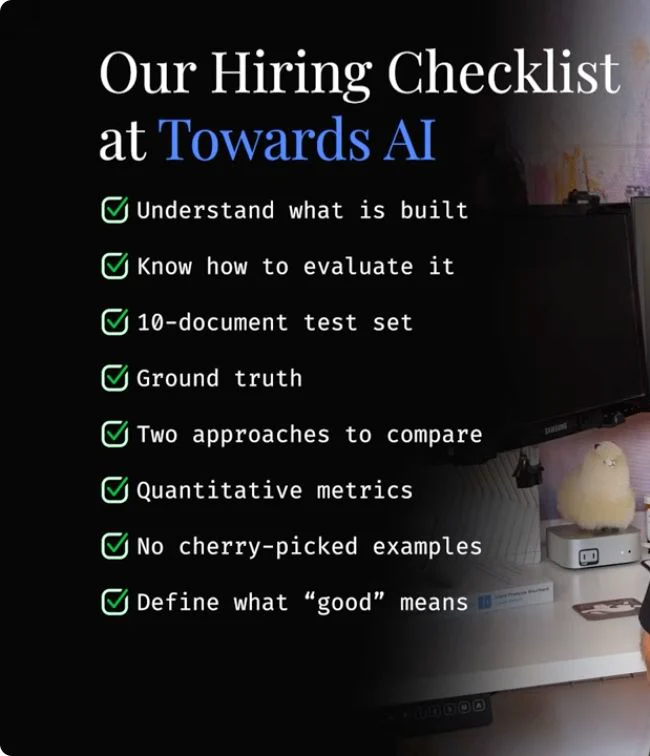
Evals are the unit tests of AI engineering.
A demo that worked on one cherry-picked example tells an interviewer almost nothing. A small evaluation set tells them how you define success and how you react when the system fails.
For a focused project, ten carefully chosen examples can be enough to demonstrate the habit. Create ground truth. Compare at least two approaches. Report quantitative results. Inspect the errors and explain what you would try next.
Cost belongs in the same evaluation. Cursor’s internal CursorBench 3.1 results illustrate the point. Composer 2.5 scored 63.2% at an average cost of $0.55 per task. Opus 4.7 Max scored 64.8% at $11.02 per task. That is about 20x the cost for a 1.6 percentage-point gain in that benchmark. The expensive model may still be the right choice for some tasks, but the decision needs evidence.
3. Defend
An interviewer should be able to ask why you selected the model, framework, retrieval strategy, deployment pattern, or database, and get a real answer.
“The agent chose it” is not an answer.
Explain the alternatives you considered. Show the data that changed your mind. State what you did not finish and why. Describe where the system fails, what it costs, and what you would do before exposing it to real users.
This is the part coding agents cannot fake for you. They can generate code and documentation. They cannot give you judgment you never developed.
What modern AI take-homes look like
Good take-homes test work that resembles the job. Examples include:
- A document pipeline that extracts structured fields from varied PDFs and reports field-level accuracy.
- A production-minded RAG assistant that answers from a real documentation corpus, cites evidence, and handles a defined concurrency target.
- A multi-hop document question-answering system that tracks citations and can be evaluated on a small ground-truth set.
The project should make your reasoning visible. A strong submission usually includes:
- A narrow, explicit scope.
- A running baseline.
- A small but verified test set.
- At least two compared approaches.
- Quantitative quality and cost results.
- Error analysis.
- Tests and reproducible setup instructions.
- A README that explains assumptions, tradeoffs, and next steps.
The output matters. Your decisions matter more.
The AI engineer portfolio that gets callbacks
Portfolios that get skipped
The same weak patterns appear repeatedly:
- A generic GPT wrapper with no user, business value, or evaluation.
- A familiar tutorial dataset with no new engineering work.
- A fine-tuned model with no serious baseline comparison.
- Several school projects that stop before deployment, evaluation, monitoring, or maintenance.
These projects may have been useful learning exercises. They do not yet prove that you can own an AI product.
Portfolios that stand out
The stronger pattern is simpler: one to three polished projects across the AI lifecycle.
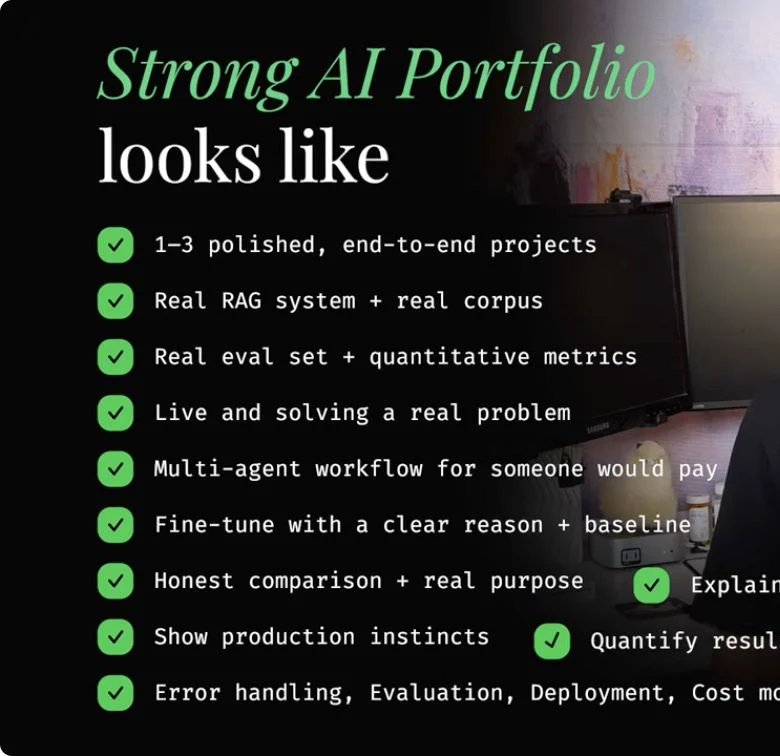
A useful project might be a RAG system over a real corpus with a verified eval set, a multi-agent workflow that completes an outcome someone values, or a fine-tune with a clear reason and a strong baseline. It should show production instincts:
- Error handling.
- Evaluation.
- Deployment.
- Monitoring.
- Cost awareness.
- Decisions you can explain.
Quantify the outcome when you can. “Reduced manual review time by 80%” is more meaningful than “improved performance,” assuming the measurement is real and documented.
Three red flags to remove
- No baseline. Improvement has no meaning if you cannot say what you beat.
- Incorrect technical claims. Prompt engineering is not fine-tuning. Use precise language.
- Dead repositories. A broken setup or dead link signals that you do not maintain what you ship.
Before applying, clone each public project into a fresh environment and follow your own README. If it does not run, fix it or remove it from the portfolio.
Choose the AI engineering path you actually want
There are at least two different career paths hiding under the same label.
Path 1: frontier labs
Vlad Feinberg’s guide to landing a frontier-lab role describes two valuable edges of the LLM stack.
Below the model are kernels and systems work: the code that makes neural-network operations run efficiently on accelerators. Above the model are rigorous agentic loops: controlled experiments and systems that make models produce useful outcomes.
This path rewards mathematical maturity, systems thinking, careful experimentation, and public technical work. A serious portfolio might reproduce scaling exercises in JAX, implement a small transformer, optimize a Pallas kernel, or build a controlled agent experiment with a real benchmark.
It is specialized and demanding. If that work sounds exciting, follow the primary sources and build at the edge where labs need help.
Path 2: product AI engineering
Most AI engineering jobs are closer to products and customers. Product AI engineers connect data pipelines, retrieval, agents, evaluation, deployment, monitoring, security, and cost.
Titles in this lane include RAG engineer, agent engineer, AI safety engineer, and forward-deployed engineer. The common skill is ownership. You can take a problem from messy requirements to a system that people can use and the team can operate.
This path is more accessible without a research background, but it is not shallow. Reliable product AI requires disciplined engineering and a strong understanding of model behavior.
Use coding agents like a senior engineer
Your use of Claude Code, Cursor, Codex, or another agent is part of the interview now. The important question is not whether you used one. It is whether your workflow made the result more reliable.
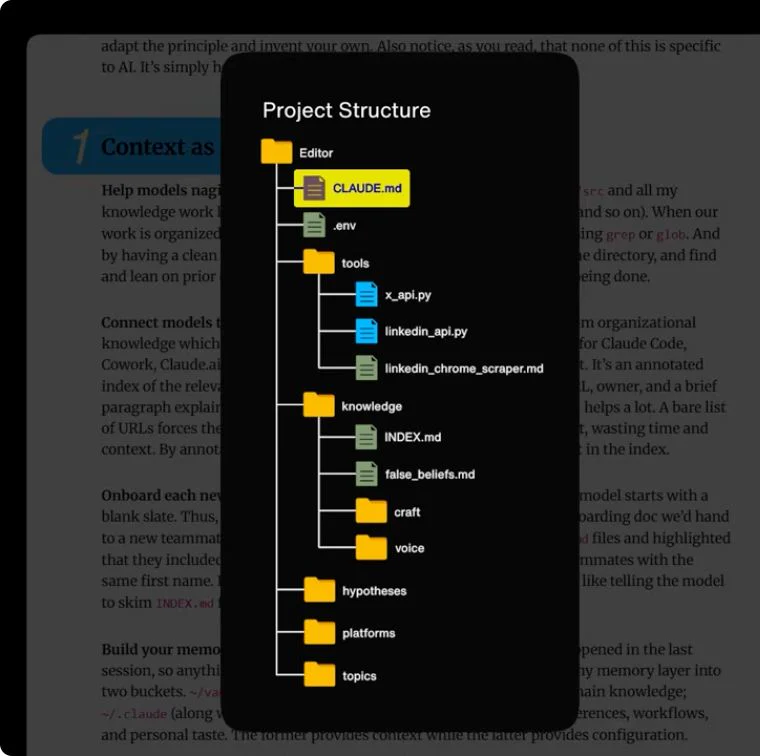
Eugene Yan’s framework for working and compounding with AI is useful here.
Context is infrastructure
Taste is configuration
Write down your conventions, review standards, failure modes, and preferences. If a workflow repeats, turn it into a reusable skill or procedure.
Verification enables autonomy
Give the agent tests, evals, linters, build commands, and visible success criteria. If it can run the check, inspect the result, and repair a failure, you can delegate a larger unit of work.
Scale through delegation
Move from approving every line to writing clear specs and reviewing complete units. Parallel sessions or subagents can help, but only when tasks are isolated and success is easy to verify.
Close the loop
Every repeated correction is a missing rule or check. Phrases such as “did you check” and “still wrong” point to workflow gaps. Capture the lesson so the next run starts better.
Avoid vibe coding in high-risk code
Fast agentic coding is useful for prototypes, UI work, boilerplate, and exploration. It becomes dangerous when the first generated answer reaches authentication, payments, sensitive data, authorization, or infrastructure without review.
Use a hybrid approach:
- Let agents accelerate low-risk implementation.
- Write or define tests before delegating critical behavior.
- Manually review security boundaries, data validation, payments, and infrastructure.
- Remove secrets and verify dependency versions.
- Understand every important change you submit.
The goal is not to prove that you avoided AI tools. It is to prove that you used them professionally.
What to build this weekend
Pick one small product idea and complete this loop:
- Define the user and the useful outcome.
- Collect a small, varied test set and verify the ground truth.
- Build the simplest end-to-end baseline.
- Compare it with a second approach.
- Measure quality, latency, and cost where relevant.
- Inspect the failures.
- Add tests and reproducible setup instructions.
- Deploy it or explain the exact path to deployment.
- Write a README that defends every major decision.
- Review all agent-generated code you would be asked to explain.
That project will not guarantee a job. It will give you something much more useful than another certificate: evidence that you can do the work.
Frequently asked questions
How should I prepare for an AI engineering interview in 2026?
Practice shipping a small end-to-end system. Add a baseline, ground-truth test set, quantitative evaluation, error analysis, tests, deployment notes, and a README that explains your tradeoffs.
What should be in an AI engineer portfolio?
Include one to three polished projects that solve a real problem and show evaluation, deployment, monitoring, cost awareness, and clear technical decisions. Fewer finished projects are better than many generic demos.
Can I use coding agents in a take-home interview?
Usually, yes, if the company allows it. Use them transparently and professionally. Verify the output, understand the code, protect secrets, and be ready to defend every important choice.
Do AI engineers still need algorithms and theory?
Yes. The required depth depends on the role. Frontier-lab and systems roles demand much more math and low-level work. Product AI roles still need solid software fundamentals, but interviews often put more weight on shipping, evaluation, and judgment.
What is the difference between a product AI engineer and a frontier-lab engineer?
A product AI engineer integrates models into reliable user-facing systems. A frontier-lab engineer may work closer to model training, kernels, scaling systems, or rigorous agent research. The portfolios and interview preparation are different.
What is the biggest portfolio mistake?
Showing a polished output without evidence that it works. Add a strong baseline, real evaluation data, failure analysis, and a clear explanation of cost and architecture tradeoffs.
Sources
- LinkedIn Labor Market Report: Building a Future of Work That Works, January 2026
- Cursor Developer Habits Report, Spring 2026
- How to Work and Compound with AI, Eugene Yan
- How to Land a Frontier Lab Job, Vlad Feinberg
FAQ
How should I prepare for an AI engineering interview in 2026?
Practice shipping a small end-to-end system with a baseline, verified test set, quantitative evaluation, error analysis, tests, deployment notes, and a README that explains your tradeoffs.
What should be in an AI engineer portfolio?
Include one to three polished projects that solve a real problem and show evaluation, deployment, monitoring, cost awareness, and clear technical decisions.
Can I use coding agents in a take-home interview?
Usually, if the company allows it. Use them transparently, verify the output, protect secrets, understand the code, and be ready to defend every important choice.
Do AI engineers still need algorithms and theory?
Yes. Frontier-lab and systems roles demand deeper math and low-level work, while product AI roles emphasize software fundamentals, shipping, evaluation, and judgment.
What is the difference between a product AI engineer and a frontier-lab engineer?
Product AI engineers integrate models into reliable user-facing systems. Frontier-lab engineers may work closer to model training, kernels, scaling systems, or rigorous agent research.
What is the biggest AI engineer portfolio mistake?
Showing a polished output without evidence that it works. Add a baseline, real evaluation data, failure analysis, and clear cost and architecture tradeoffs.