
The short version
Llama 3.1 mattered in July 2024 because Meta released a 405-billion-parameter model, smaller 70B and 8B variants, a 128K context window, and a license that supported deployment, fine-tuning, and distillation outside one closed API. The business case was control and customization, but the article's benchmark, pricing, infrastructure, provider, and future-feature claims are a release-era snapshot, not current purchasing guidance.
- Llama 3.1 makes a frontier 405-billion-parameter model available with open weights and a license that permits distillation.
- Businesses gain control, customization, and infrastructure choice, but must plan for the necessary skills and GPUs.
- Generic benchmarks are not enough. Teams also need human evaluations and tests designed around their own business use cases.
As you probably already know, earlier this week Meta announced Llama 3.1, marking a very important milestone in AI, especially because it is open source and has impressive capabilities. It is the first frontier open source LLM to compete with GPT-4.
In this edition, we wanted to cover the news a little differently from everything we have seen online by focusing specifically on the kinds of questions managers and other people in leadership positions might want or need answered.
So here they are… the 10 (+1) questions whose answers you need to know:
1. Why is Llama 3.1 so important?
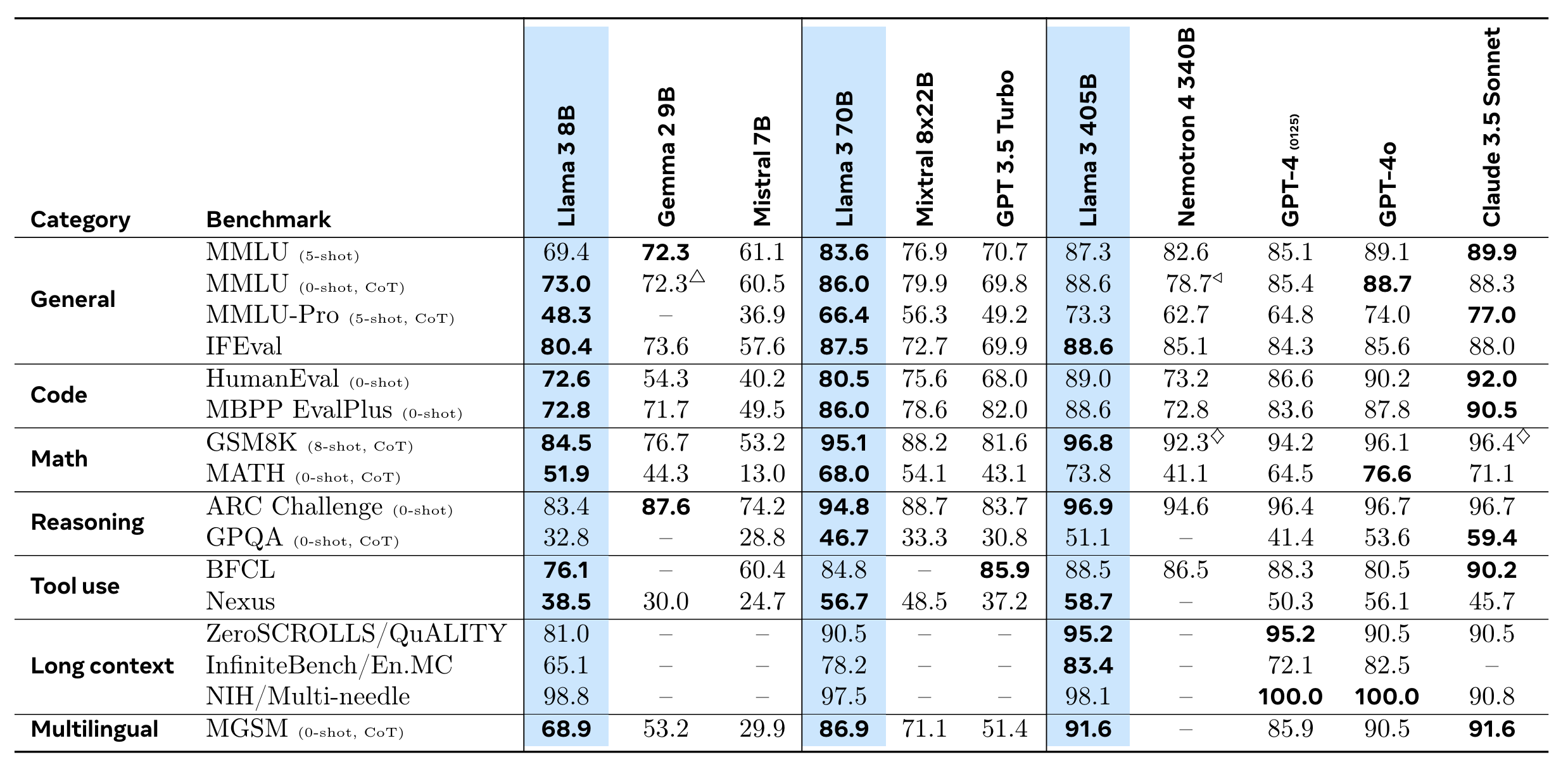
Llama 3.1 is a groundbreaking open source AI model with 405 billion parameters that supports multilingual use (a fun detail: this capability emerged from large datasets and works with surprisingly little data in “other languages”!), coding, reasoning, and tool use, matching or surpassing closed models such as GPT-4-0125 across various benchmarks. Its open source nature democratizes access to frontier AI technology (following in the footsteps of GPT-2, GPT-Neo, and GPT-J), allowing businesses and developers to use leading LLMs without provider lock-in. At the same time, its competitive performance and broad feature set make it highly attractive to researchers and businesses looking to fine-tune and deploy advanced AI at a lower cost.
2. How does the open source nature of Llama 3.1 compare favorably with closed source models, and what are the long-term strategic benefits of adopting an open source AI model such as Llama 3.1?
Llama 3.1’s open source nature enables greater customization, transparency, and community-driven improvements, giving organizations the flexibility to fine-tune models for their specific needs without provider lock-in. Long-term strategic benefits include less dependence on a single provider (you do not want to depend on OpenAI), potential cost savings (for example, hosting a smaller fine-tuned version yourself instead of paying per token), better explainability (compared with an API), control over server and inference speed, and more innovation through community contributions. Ultimately, this can lead to broader economic and social benefits.
3. What partnerships and integrations with public cloud providers, for example Together AI, Groq, Fireworks, AWS, and Azure, are available to support our deployment of Llama 3.1, and how can my team use Meta’s cloud partnerships to experiment with and implement Llama 3?
Meta partnered with major cloud providers such as AWS, Azure, Google Cloud, and Oracle to make Llama 3.1 easily accessible, offering complete service suites that let developers fine-tune and deploy Llama models. Emerging LLM providers such as Together AI, FireworksAI, and Groq also offer low prices and fast token-processing speeds, giving teams ways to experiment with and implement Llama 3.1 without a significant infrastructure investment while still considering cost efficiency. Another fun detail: Meta gave Groq access to a randomly weighted version of the Llama 405B model before release so it could prepare and optimize model distribution.
4. What infrastructure and resources are required to deploy and run the Llama 3.1 models, especially the 405-billion-parameter version, as well as the 70B and 8B versions?
The 405-billion-parameter version requires substantial GPU resources, with up to 16K H100 GPUs used for training, each with 80 GB of HBM3 memory, connected through NVLink inside servers equipped with eight GPUs and two CPUs. The smaller versions (70B and 8B) have lower resource requirements, using Nvidia Quantum2 InfiniBand fabric with 400 Gbps interconnections between GPUs. This makes them more accessible to many organizations, while storage requirements include a distributed file system providing up to 240 PB of storage with peak throughput of 7 TB/s. Recently, Elie Bakouch, known for training LLMs at Hugging Face, shared that it is possible to fine-tune Llama 3 405B using 8 H100 GPUs.
5. What specific advantages does Llama 3.1 offer in terms of performance, cost, and potential savings compared with closed models such as GPT-4o?
Llama 3.1 offers significant performance advantages, matching or surpassing GPT-4 on many benchmarks while being more economical to use. According to an interview with Mark Zuckerberg, inference operations cost about 50% less than comparable closed models such as GPT-4o. The open source nature allows more effective customization and fine-tuning, potentially producing better performance on specific tasks at a lower cost than closed models. The ability to run the model on premises or with preferred cloud providers also gives organizations more control over infrastructure costs.
6. What skills and team do we need to work effectively with Llama models for our specific use cases?
a) For fine-tuning, training, and distillation…
A team needs expertise in machine learning, especially natural language processing and transformer architectures. Skills in data preprocessing, model optimization, and distributed computing are important. Knowledge of PyTorch and experience training models at scale are essential. The team should include machine learning engineers, MLOps specialists, and developers.
b) For deployment and use as-is
To deploy and use ready-made Llama models, the required skills shift toward software development and cloud services expertise. Familiarity with cloud computing platforms such as AWS, GCP, or Azure and knowledge of containerization tools such as Docker are important for setting up and maintaining the model infrastructure. Understanding model inference APIs and optimization techniques for efficient deployment is also essential. vLLM is a fast and easy-to-use library for LLM inference and serving. Domain expertise for aligning model output with specific business needs will make deployments both effective and relevant to your organization’s goals. DevOps professionals or AI engineers interested in practical AI applications are well suited to this work.
7. What support and tools are available for fine-tuning, distillation, and post-training of Llama 3.1 models to meet our specific needs?
Meta and its partners are working on comprehensive support for fine-tuning, distillation, and post-training of Llama 3.1 models, including services from Amazon, Databricks, and NVIDIA for model customization. Companies such as Scale.AI, Dell, Deloitte, and others are ready to help businesses adopt Llama and train custom models with their own data. Techniques such as supervised fine-tuning (SFT), rejection sampling (RS), direct preference optimization (DPO), and QLORA + FSDP, available in Hugging Face’s TRL library, are used for model alignment. Efficient deployment tools include low-latency, low-cost inference servers from innovators such as Groq. For the 405B model, a minimum node of 8 H100 GPUs is recommended for fine-tuning.
8. What are the main benefits of synthetic data generation, and how can our organization use it to build better AI models? What are the potential benefits and risks?
Synthetic data generation offers significant benefits, including lower costs, scalability, and the ability to generate large amounts of high-quality training data without the constraints of annotator expertise. Organizations can use synthetic data to improve model performance through methods such as back-translation for documentation and multilingual capabilities, improving both the breadth and quality of training datasets. However, risks include potentially propagating incorrect data or biases, requiring robust quality-control and verification processes to ensure data fidelity and model reliability.
9. How should we approach evaluation and benchmarking with Llama 3.1 to make sure the models meet our specific business needs?
You should evaluate Llama 3.1 the same way you evaluate other models. Benchmark it against models of a similar size across various tasks using well-established academic benchmarks and thorough human evaluations. In addition, developing custom benchmarks and human evaluations relevant to specific business use cases helps assess performance on company-specific tasks and data. Decontaminating the data and aligning evaluation methods with specific business needs will help ensure that Llama 3.1 meets performance and functionality requirements.
10. What are the practical applications of the 405-billion-parameter model with a 128K-token context window, and how can it benefit our business processes, especially data-intensive applications?
The 405-billion-parameter model with a 128K-token context window can perform tasks such as complex reasoning, summarizing long documents, and applications that require extended context. For example, to understand a complex codebase, you can put all the code into the prompt, allowing the model to analyze and reason about the entire code structure and its interactions. Another key benefit is the ability to distill this large model into smaller models (8B or 70B), since the new license explicitly allows it, unlike OpenAI’s models. We expect this to be the main use of the larger model because it is difficult for individuals and small businesses to host it themselves.
11. What future developments and features can we expect from Llama models, especially in terms of multimodal capabilities, and how should we prepare for these advances?
Future Llama models should integrate advanced multimodal capabilities, including understanding images, video, and speech. We believe organizations should prepare by investing in infrastructure that supports multimodal data integration. Staff should think about how to use these advanced features and consider how they could improve existing AI applications. In addition, the open source community will likely optimize this generation of models, making them faster at inference and reducing compute requirements, which will lead to more efficient AI systems that are accessible to everyone.
FAQ
Why is Llama 3.1 important?
It combines frontier performance, a 405-billion-parameter model, and open weights that make advanced AI more accessible.
What are the main advantages of an open source model?
It provides more control, transparency, and customization while reducing dependence on a single provider.
Where can Llama 3.1 be deployed?
Meta works with AWS, Azure, Google Cloud, and Oracle, while Together AI, FireworksAI, and Groq also offer inference options.
What infrastructure does the 405B model require?
Running and fine-tuning it requires several high-end GPUs. The article specifically cites at least eight H100 GPUs for fine-tuning.
Can Llama 3.1 cost less than a closed model?
Yes, depending on the provider and deployment. Open weights also let teams optimize or host a version tailored to their own needs.
What skills are needed to use Llama 3.1?
Fine-tuning requires ML, PyTorch, and distributed computing skills. Deployment relies more on software, cloud, and DevOps expertise.
Why use the 405B model for distillation?
Its license lets teams transfer capabilities into smaller 8B or 70B models that are easier to operate.
How should a business evaluate Llama 3.1?
It should combine established benchmarks, human evaluation, and custom tests based on its own tasks, data, and requirements.