
The short version
Breaking into AI does not always require a machine learning PhD; open-source research, side projects, and creating your own job can provide alternative paths. For applications, Brian Burns recommends tailoring a resume around quantifiable impact, sharing work online, building industry relationships, and using the interview to tell a concrete project story with challenges you overcame instead of repeating what the recruiter already read.
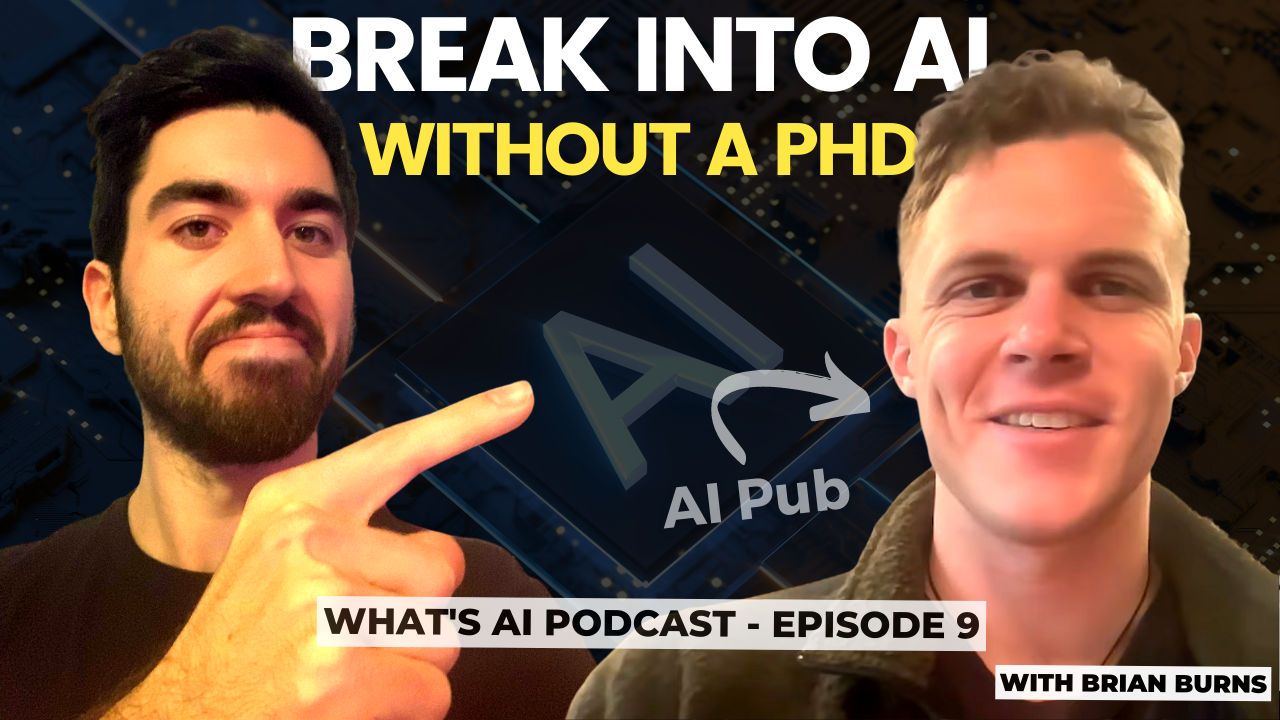
Are you considering pursuing a Ph.D. in machine learning? Before you take the plunge, take a moment to listen to this insightful interview with Brian Burns, a Ph.D. candidate at the University of Washington and founder of the AI Pub Twitter account.
In this episode, we first dive into academia vs. Industry, where Brian sheds light on the pros and cons of pursuing a machine learning Ph.D. program. Spoiler: while it can help break into the field and for specific research goals, there are other ways to learn quickly and find opportunities!
We pursue the discussion with some of the alternative paths… Machine learning research has evolved significantly over time, and alternative pathways like joining open-source research organizations or working on side projects might actually prove to be more useful than graduate studies for some individuals.
But how to get into the AI field without those studies? Just jump in projects, and it’s over? Not really, you will also most probably need to make money, and thus find a job (or create yours like Brian). Here are some of Brian’s tips on landing this first job…
[
Louis-François Bouchard’s Weekly AI Digest | Substack
](https://louisbouchard.substack.com/)
Personalizing resumes: Brian emphasizes the importance of showcasing quantifiable impacts the candidate has made, whether it’s speeding up a service, improving a model’s performance, or generating revenues for an employer.
The power of brand and online presence: Don’t underestimate the influence of a strong personal brand and an online profile when it comes to recruiting. Share your work, collaborate, and use social media to your advantage.
Tune in to the interview to learn even more insights to get into AI, grow a Twitter page, host a podcast, ace interviews, build a better resume, and the other topics Brian is an expert in… (or listen on Spotify or Apple Podcasts)
FAQ
Can someone enter AI without a machine learning PhD?
Yes. Strong projects, visible technical work, and evidence of learning can open routes that do not require doctoral study.
When is a PhD useful for an AI career?
It is useful for research-heavy roles that demand deep specialization, publishing experience, and independent investigation.
What should an AI resume emphasize?
Show the problems you solved, technical decisions you made, and outcomes you can explain in detail.
How should candidates prepare for AI interviews?
Practice explaining fundamentals, project tradeoffs, failures, and the reasoning behind implementation choices.
Why does the episode discuss creating your own job?
Building a product, publication, or business can demonstrate initiative while creating an alternative to a conventional hiring path.